Pool code fencing
Pool barrier fencing built to California code
Sixty inches, a two-inch ground gap, nothing a four-inch sphere passes, and a gate that latches itself.
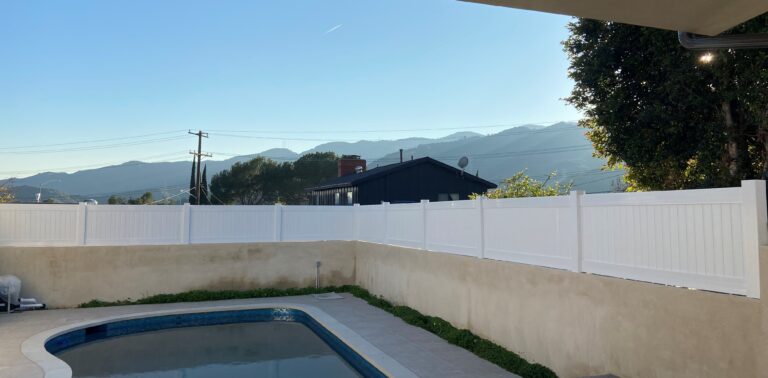
Pool barrier fencing
A pool fence that passes, first time
California sets the specification for a pool barrier in writing, down to the inch. We build to it, and we would rather explain it to you now than have an inspector explain it to you later.
Both materials work. A solid vinyl panel gives you a barrier and privacy in one run; aluminum keeps the water in view from the house, which is a safety argument as much as an aesthetic one.
The specification
What the code actually says
California Health and Safety Code section 115923 sets out what an enclosure has to do. Four numbers and one gate rule:
60 inches tall, minimum
Measured on the outside, from the ground a child would stand on. Sixty inches is five feet — taller than the four-foot fence a lot of older pools still have around them.
2 inches at the bottom, maximum
The gap between the ground and the bottom of the enclosure. On a slope this is what decides whether the run is stepped or raked.
Nothing a 4-inch sphere passes through
Which fixes picket spacing on an open fence, and is why an aluminum pool fence is not the same fence as an aluminum garden fence.
Nothing to climb
No protrusions or cavities that work as a handhold or foothold for a child under five. The statute sets the principle rather than a list, which is why we keep horizontal rails off the outside face.
And the gate
It has to open away from the pool, close itself, and latch itself, with the release no lower than 60 inches above the ground. Every pool gate we hang is steel-framed for that reason: a self-closing hinge pulls on the leaf several times a day, every day, and a gate that has dropped out of square stops latching — which means it stops complying.
The other half
A fence is one of two required features
When a permit is pulled for a new pool or spa, or for remodelling one, section 115922 requires at least two of seven drowning-prevention features. An enclosure is the first of the seven. It is not, on its own, all of them.
- An enclosure that isolates the pool from the house — what we build.
- Removable mesh fencing to ASTM F2286, with a self-closing, self-latching gate.
- A safety pool cover meeting ASTM F1346.
- Exit alarms on the doors and windows that open onto the pool.
- Self-closing, self-latching devices on those doors, released no lower than 54 inches.
- An in-water detection alarm meeting ASTM F2208.
- Another measure of equal or greater protection, independently verified.
Some of them cannot be paired with each other, and your city may ask for more than the state does. We build the barrier and we will tell you what we know; the permit, the inspection and the final say belong to your building department.
This is a plain-English summary of the statute, written in September 2026, not legal advice. Confirm the requirements with your city before you build.
Good to know
Pool fence questions
My pool is old and the fence is four feet. Do I have to change it?
The two-feature requirement is triggered by a permit — a new pool or spa, or a remodel of one. An existing barrier that predates it is a separate question, and the honest answer is that your city decides it. What we can say is that four feet is under the height the current code sets.
Vinyl or aluminum?
Vinyl if you want the pool out of sight from the neighbours. Aluminum if you want to see the water from the kitchen window — being able to see in is worth something that no code assigns a number to.
Can the house wall count as one side?
That is exactly the distinction the code draws: an enclosure under 115923 isolates the pool from the house. If a wall of the house forms part of the barrier, the doors through it are what has to be addressed, which is where the alarms and self-closing devices in the list above come in.
Do you pull the permit?
We build to the specification and we are happy to talk to your inspector. The permit itself is between you and the city, and we will tell you plainly what we are quoting for.
Ready for a straight line and a square gate?
Free on-site estimate across Orange County and LA County, answered the same business day.